



OpenAI unleashes ChatGPT Atlas web browser
OpenAI has released its AI-powered web browser, it’s called ChatGPT Atlas. The browser is based on Chromium, and supports extensions that are available on the Chrome Web Store. Atlas has a sidebar that allows users to quickly access ChatGPT, and ask the AI to summarize the page, explain the content. The new tab page has a large search bar, which you can use to visit websites, or search the web, or interact with the bot.

Users can turn on browser memories, to allow the chatbot to remember details and access the browser history, using the information to provide relevant answers to your queries. It is also possible to interact with ChatGPT in Atlas using their voice too. The browser supports an Agent mode, which can be used to automate tasks from start to finish, but this is only available for ChatGPT Plus, Pro and Business users. ChatGPT Atlas is currently available for Mac, but OpenAI says that it is working on a Windows version and an Android app along with new features that were requested by users. The browser will compete with Google Chrome, Microsoft Edge, Perplexity Comet, which have introduced AI-powered features in the recent months.
Mozilla is testing 2 widgets for Firefox’s new tab page
Mozilla has announced that 2 widgets are now available for testing in the new tab page on Firefox. These experimental features can be enabled via Firefox Labs in the stable version of the browser. The widgets that have been introduced are Lists and Focus Timer. Once enabled, they will appear on every new tab page that you open.

The Focus Timer widget, as the name suggests, lets you start a timer, and will alert you when the countdown ends. It is customizable, so you can set it to any duration of your choice. The Lists widget allows users to create to-do lists, add items to it, and mark them as done when completed. While the lists don’t sync to the cloud, users can copy them to the clipboard, and save them in other apps, or share them with other users. The widgets can be disabled easily, or you may choose to disable the one that you don’t like.
YouTube adds time limit controls for scrolling the Shorts feed
YouTube has announced that it is adding time limit controls in its mobile app, to help users restrict the amount of time they spend scrolling the Shorts feed. Short video formats like TikTok, Instagram, Facebook Reels, YouTube Shorts have gained popularity over the years. A few months ago, YouTube’s CEO had revealed that Shorts are averaging 200 billion views on a daily basis.

Sadly, short videos have led to an addiction of sorts, often called doomscrolling. YouTube wants to help address this problem by setting a timer, essentially a daily time limit for scrolling the Shorts feed. Users can customize it from the YouTube app’s Settings. But this doesn’t block Shorts, it is a merely a pop-up reminder to alert the user they have exhausted their time limit for the day. The user can dismiss it and continue watching the Shorts, or stay disciplined by cutting down the time scrolling on their mobile device. This is a welcome improvement that could aid in maintaining the digital wellbeing of users. The feature will be available in parental controls, but kids in the family won’t be able to dismiss the prompt.
Wikipedia blames decline in traffic on AI search
The Wikimedia Foundation has revealed that it has observed a significant drop in page views from human users on Wikipedia. According to its internal investigations, the foundation observed a sudden spike in network requests from Brazil earlier this year. However, after updating its bot detection methods, and re-analyzing the data, Wikimedia discovered that a lot of the traffic were bots disguised to avoid detection. It says that this resulted in Wikipedia traffic declining by 8% compared to numbers from 2024.
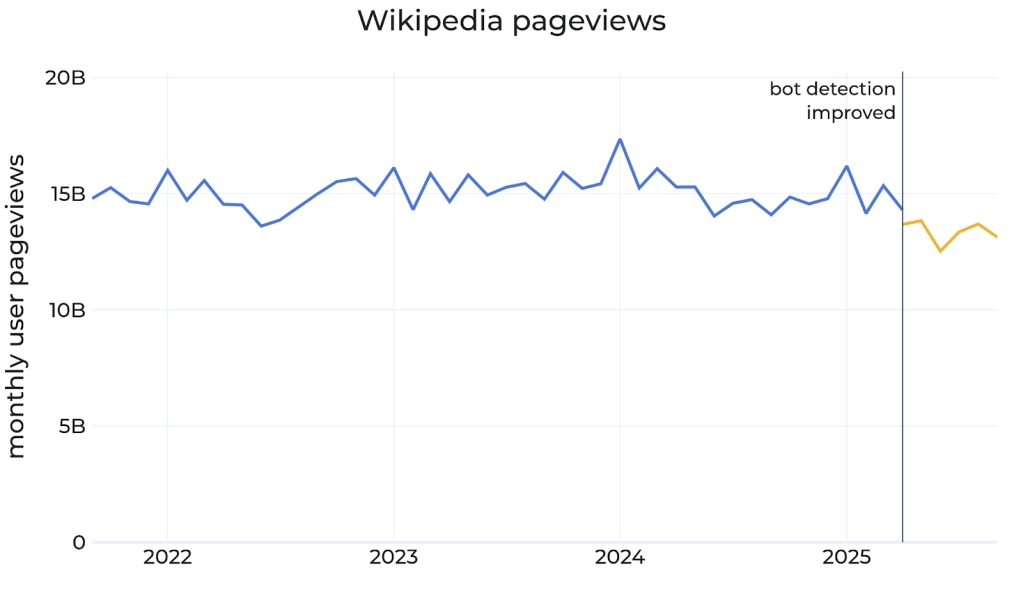
Contrary to Google’s denial that AI search does not steal traffic from websites, Wikimedia believes that AI search engines are the culprits, and that many of them fail to attribute Wikipedia and other publishers as the source, even if they do use their data sets to train AI models. When users search for something, AI search summarizes the information, the user reads it and ends the session. If users stop visiting sources like Wikipedia, it could affect the platform and other websites. Wikimedia has called for AI services to credit their sources properly with links, and encourage users to visit the websites.
Microsoft issues emergency update to fix WinRE issues on Windows 11
Microsoft has fumbled a Windows update yet again. The October Security Updates, that were released earlier this month as part of the KB5066835 Windows Update, had introduced a bug that affected the Windows Recovery Environment. Users had reported that they were unable to navigate WinRE using their USB devices such as keyboards and mice. This left them unable to perform recovery actions. The only workaround in case of boot failure, was to use a Windows installation media, or reinstall the operating system.

Microsoft acknowledged it as a known issue, and issued an out-of-band update this week to address the problem. KB5066835 is now available for Windows 11 version 24H2 and 25H2, and patches the bug, thus allowing USB devices to function normally in WinRE. The latest patch is available via Windows Update, and the Microsoft Update Catalog.
Separately, Microsoft also explained why Windows may install old drivers on some PCs. The Redmond company has also attracted criticism for sneakily suggesting ChatGPT, Perplexity users to Try Copilot. Microsoft revealed that Copilot Vision’s AI avatar is called Mico, and is designed to offer a personalized visual experience for users.
Windows 11 is preventing users from previewing downloaded files
Microsoft has made a change to File Explorer that may annoy some users. Windows 11’s built-in file manager will no longer allow users to preview files that they have downloaded from the internet. Explorer’s Preview Pane won’t display the contents of the file when you select it.

When you download a file from the web, they are tagged as originating from a remote source, and Windows 11 deems them as potentially unsafe. This change arrived as part of the October Security Update. Microsoft claims that this restriction was made to address a vulnerability that is affecting the preview pane. Users have criticized the move to block Previews, instead of fixing the vulnerability that affects the feature.