



ChatGPT’s app store is here
OpenAI has launched its app directory, which allows developers to submit their apps to be integrated in ChatGPT, using a new SDK. Interestingly, OpenAI has renamed “connectors” in ChatGPT to apps. In case you didn’t know, users can access various apps inside ChatGPT, from the chatbot’s setting. Apps will need to be authorized to allow access within ChatGPT.

When that’s done, users can interact with the apps directly in the chat. OpenAI had recently announced that apps like Zillow, Canva, and Spotify were available. Last week, Adobe introduced Photoshop, Express, and Acrobat in ChatGPT. Now, new apps are available on Android, iOS and the web version of ChatGPT. It consists of various categories, and you can choose to connect to a service that you use. For example, you can access Apple Music, Dropbox, Google Drive, Booking.com within ChatGPT. Users who have the memory feature enabled may want to take note of something, apps will have access to the memory when you interact with them.
Google to discontinue its “dark web report” tool
Google has announced that it will discontinue yet another of its services. This time, it is the “dark web report” tool hat is being axed. The feature was designed to notify users when their personal information was leaked on the dark web. It scanned dark web breaches to find if a user’s name, phone number, email address, username and password leaks, and other sensitive data that was available publicly on data dumps from breaches in the dark web. Monitoring such breaches and notifying users about them could have prevented identity theft, and potential hacks.

But, less than 2 years since it was introduced, Google has decided to kill the feature. The Mountain View company says that users didn’t really found it useful, as the tool didn’t provide them steps to take when their data was leaked. Google’s “dark web feature” will no longer monitor new breaches from January 15, 2026. The tool will be discontinued on February 16, 2026.
The TikTok US sale is happening
It looks like the TikTok sale has been finalized. The China-based short-form video platform has had a rough past in the U.S. for the past five years. TikTok went dark in January 2025 in the U.S., but returned to app stores a month later. But the focus has always been on its ownership, concerning national security and user data. That could finally be coming to an end, as reports indicate ByteDance will sell its U.S. operations to local investors.

The USDS Joint Venture LLC comprising Oracle Corporation, Silver Lake, and MGX will collectively own 45% of TikTok, i.e. 15% each and another 5% will be owned by a new block of investors. 30.1% will be held by affiliates of current investors, and ByteDance itself will retain 19.9% of the company. The sale will ensure safeguarding of sensitive user data that will be stored is servers owned by Oracle in the U.S., prevent the content feed from being influenced by outside elements, moderation of content and related policies, and protect the deployment and integrity of the software/platform. The TikTok sale is expected to be completed on January 22, 2026.
Steam now tells you if a game in your cart is cheaper in a bundle
Valve has made a lot of improvements to the Steam Store over this year. Now, it has added a new feature that may help gamers save some money. Sometimes, games on Steam may be available in a bundle that contains DLCs for the game, or other games from the developer or publisher. You may even come across rare bundles where games from different companies are offered on a discount. Such bundles usually allow players to purchase games at a lower cost than if they were to buy them individually.
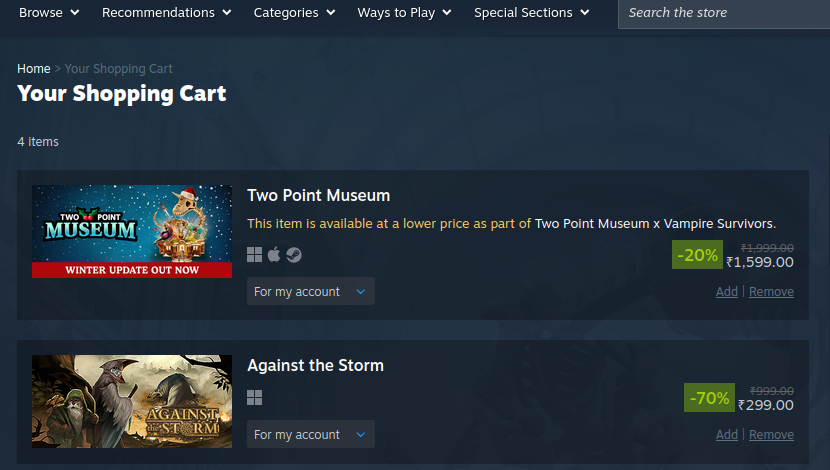
In some cases, buying a game that is part of a bundle could be cheaper than buying just the game. It’s rare, but it happens. Steam also offers publishers the option for “complete the set” bundles, which take into account items that are already in a user’s library, and lowers the price of the bundle accordingly. While these are good, there is a problem. Users may not be aware of the best prices when they are purchasing games. This is the problem that Valve has addressed with the new feature. Now, when you add a product to your cart on Steam, the website may tell you that one or more of the items are available at a lower price as part of a bundle.
This should come in to be handy during the ongoing Steam Winter Sale. Even if it just saves you a couple of pennies, it still counts. After all, a penny saved, is a penny earned.
Mozilla says AI is a big part of Firefox’s future
Mozilla’s new CEO, Anthony Enzor-DeMeo, has revealed his plans for Firefox. It looks like AI will be a big focus in the browser’s future. The nonprofit organization will not train an LLM, but it will still get an AI Mode in 2026. Users will be able to select the AI they want to use in Firefox. This news has been hotly debated among the Firefox community, who are worried about their privacy. Mozilla has stated that all AI features in Firefox will remain optional. It is clear that they want to please everyone, and that is a good sign.
 You may be aware that a huge chunk of Mozilla’s earnings come from its search deal with Google. The Mountain View company pays the nonprofit millions of dollars in exchange for promoting Google as the default search engine in the browser. Enzor-DeMeo told The Verge that he could bring in another $150 million in, by banning ad blockers in Firefox, but he wouldn’t do that as it does not feel right to do so. This statement has raised eyebrows, with some users claiming that Firefox could die if it does not support ad blockers, while others said that forks of the open source browser will save the day, if the nightmare becomes a reality.